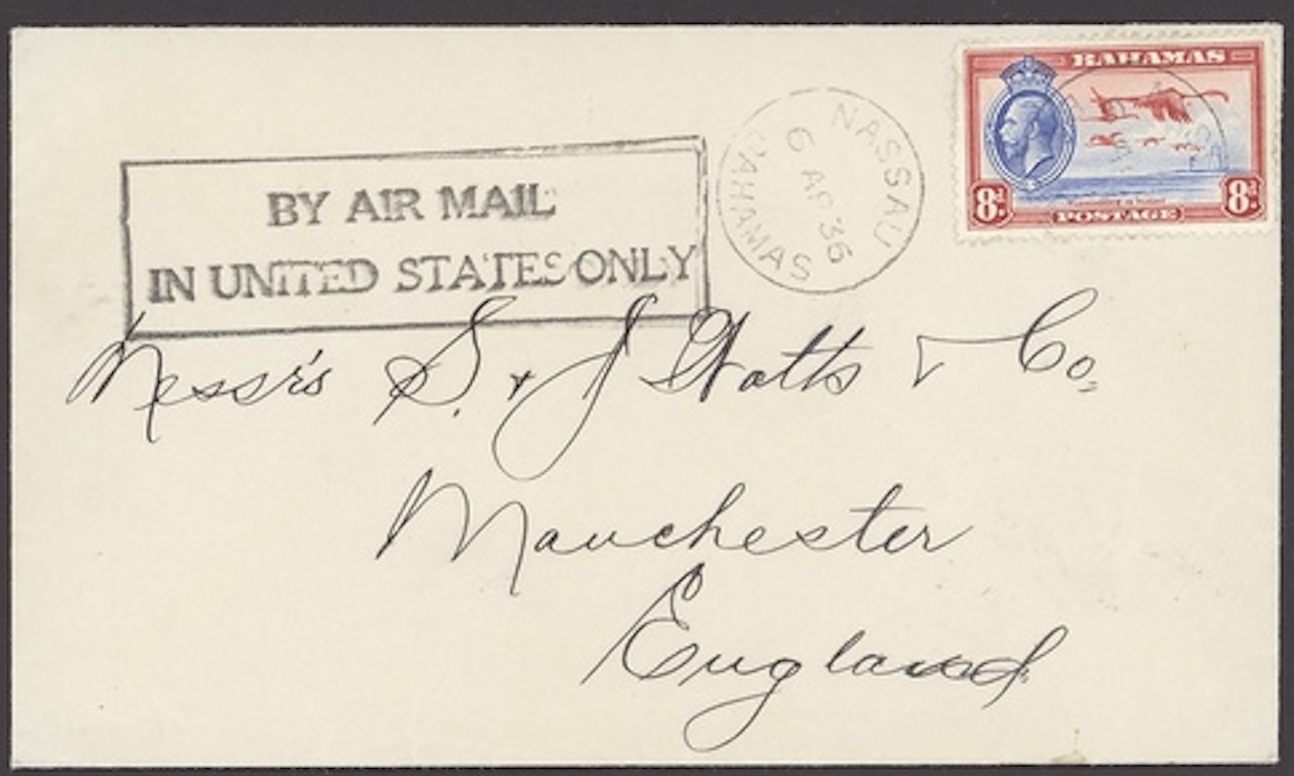
I first found this stamp on this envelope (see below). A friend in the Bahamas sent me this cover, as we call them in the hobby, and I fell for it straight away. It carries the 1935 stamp with King George V, a Nassau postmark from 1935 and a boxed “By Air Mail in United States only” marking, and it is addressed to a firm in Manchester.
I then went looking for the stamp itself, and found that there is more than one version of it. The Grand Bahama Museum explains where the design came from. Daily airmail between Nassau and Miami began in January 1930, and although no stamp was made to mark it, the 1935 Waterlow pictorial series nodded to flight. This was the first stamp in that series, printed in scarlet and ultramarine, with a flight of flamingoes. That suits a cover that went by air.
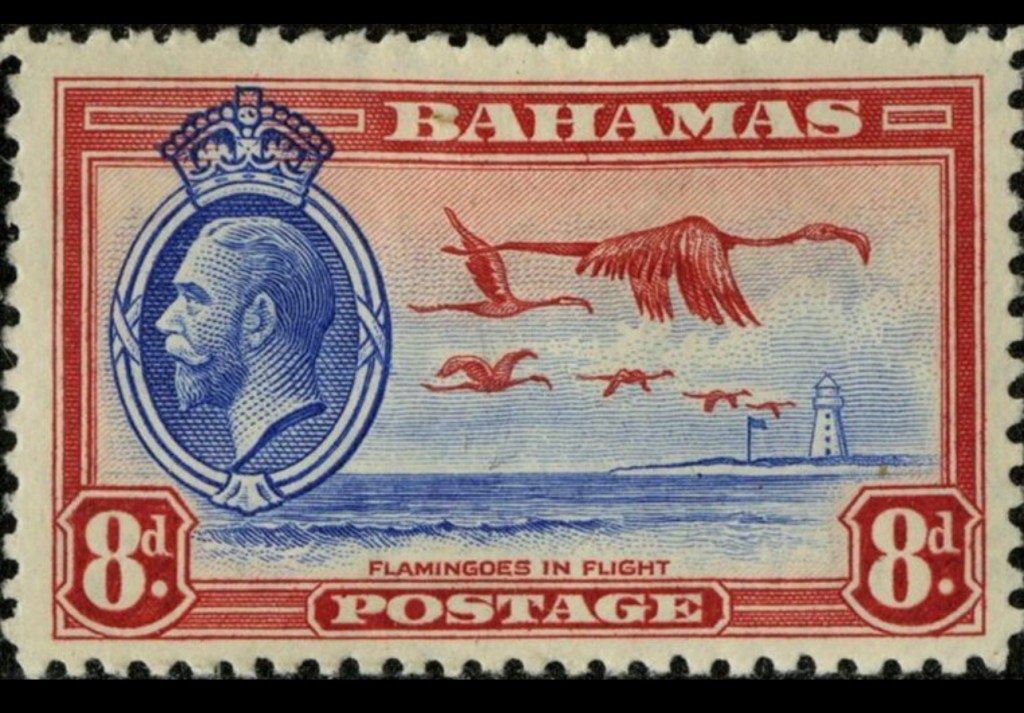
The first two versions look like the same stamp, and nearly are. Both are the Bahamas 8d “Flamingoes in Flight”, printed in red and blue. The first came out on 22 May 1935 with King George V in the oval on the left. The second has King George VI in the same oval, and it was issued in 1938.
I could have put them side by side, but it is more fun to change the king yourself. Drag the handle.
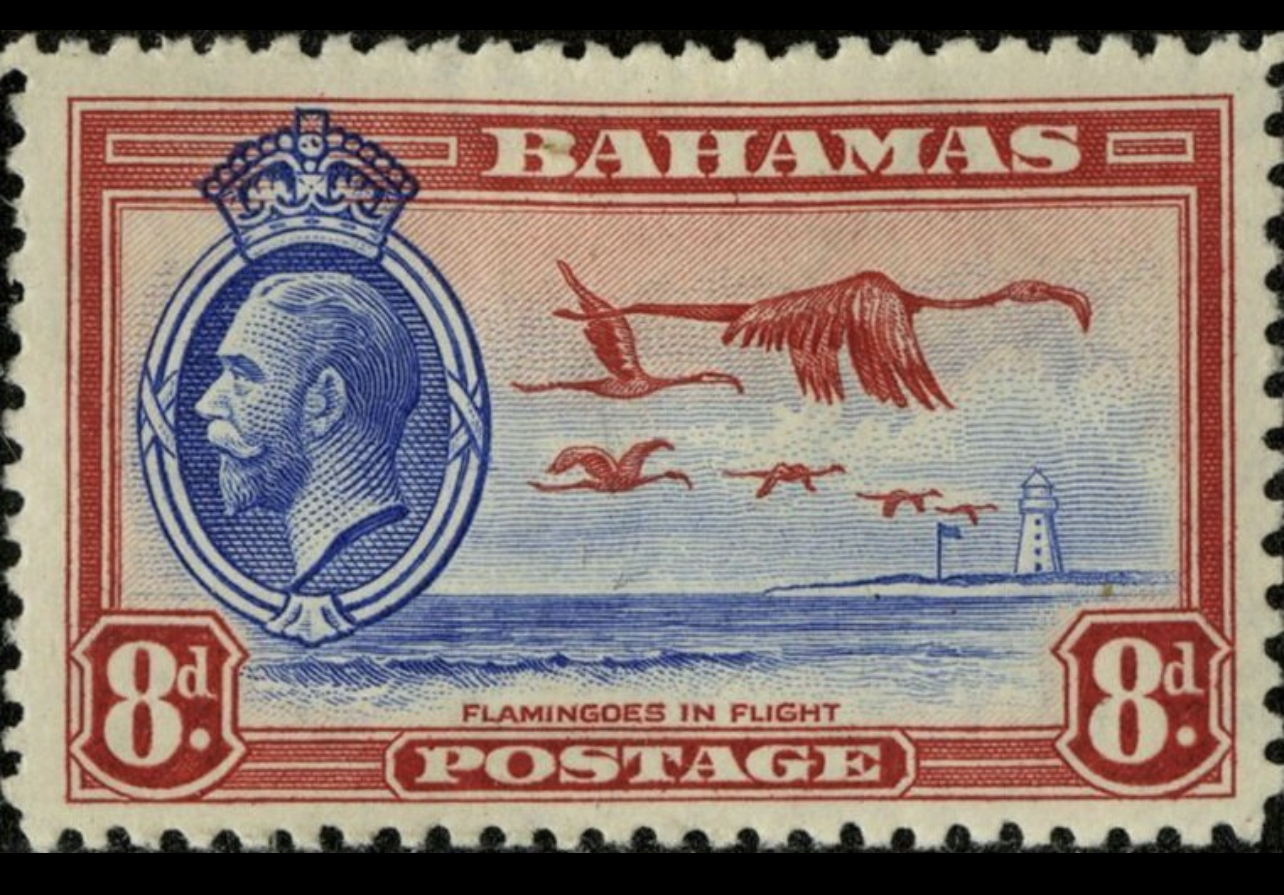
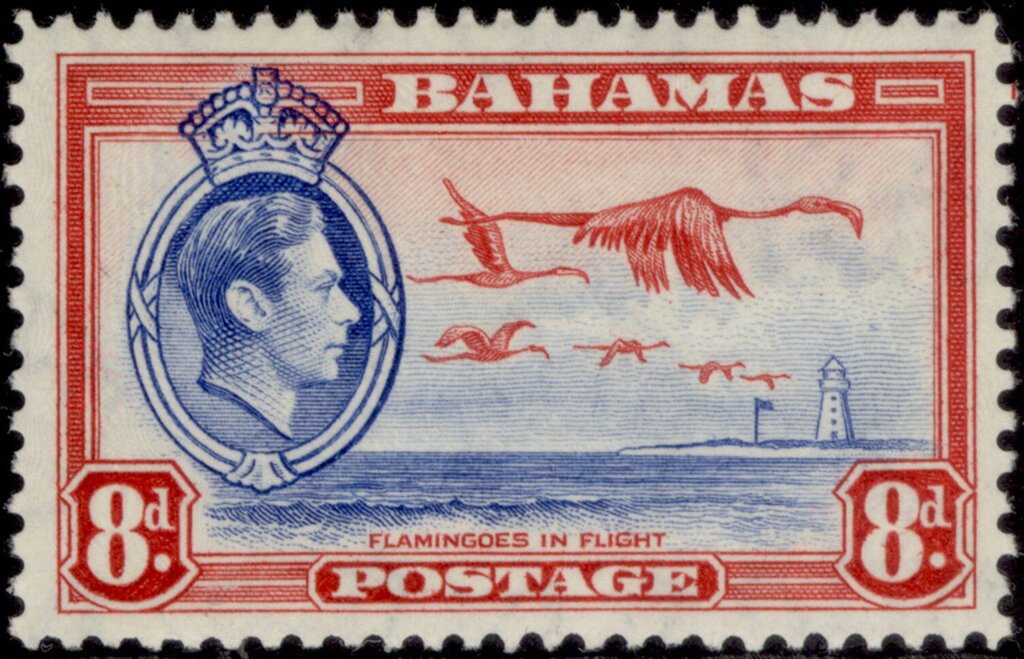
Drag the handle to change the king. 1935 George V on the left, 1938 George VI on the right.
George V died on 20 January 1936, and his eldest son, Edward VIII, abdicated before the year was out. Stamps had to change with them. When the new King George VI definitives arrived for the Bahamas, the Grand Bahama Museum notes that the new head was set within the same frame design. For this value, the artist went one step further and kept the whole picture.
The 1935 stamp is a deeper carmine red, and the 1938 one is a brighter orange-red. The blue is close on both.
I found a third version. The 1938 stamp was overprinted in black in 1942 with the words “1492 Landfall of Columbus 1942”, marking 450 years since his landfall. The overprint runs straight across the flamingoes and the sea, so it hides the picture more than any of the others.
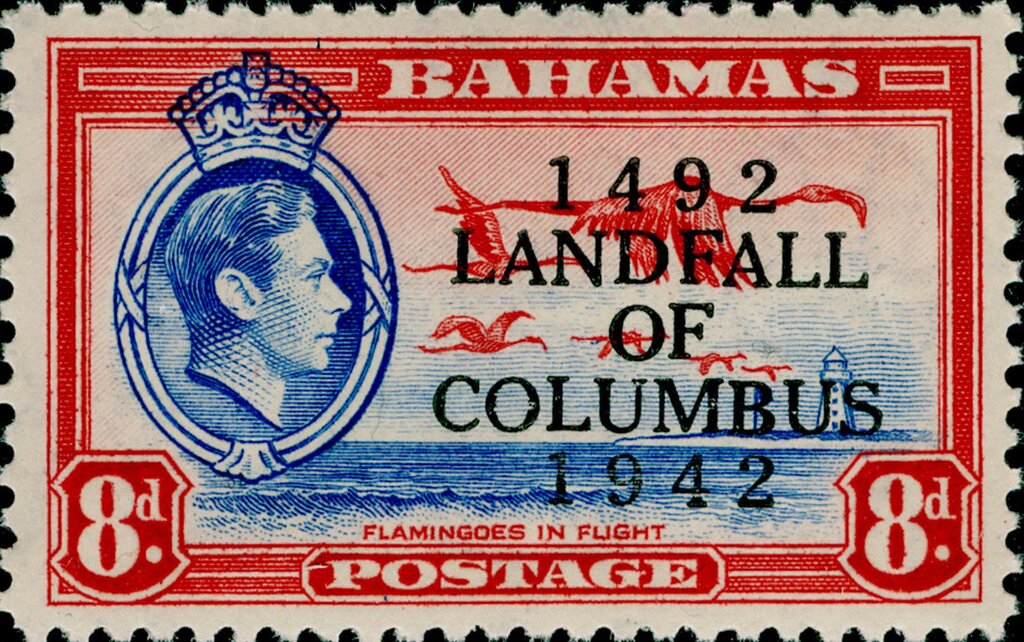
There is one detail I only spotted when I looked at the 1942 version closely, and it is the whole reason this was sent to me. On the horizon, to the right of the flamingoes, there is a small lighthouse, printed in the same blue as the sea. The overprint runs straight through it, so it is easy to miss.
The lighthouse is the Hog Island light at Nassau. It was built in 1817 and is the oldest surviving lighthouse in the West Indies. It stands at the western tip of what is now Paradise Island, and it marks the entrance to Nassau harbour. I have been to Hog Island myself, and I will write about that visit in a later post.
The overprint has a story of its own. There was no new stamp for the 450th anniversary of Columbus. The Bahamas overprinted stamps it already had, and the work was done at the offices of the Nassau Guardian newspaper in October 1942. In the first batch a damaged letter turned the L of COLUMBUS into something close to an I, so a few stamps read COIUMBUS. The letter was replaced and later batches are normal. The fault only affected the three horizontal pictorial stamps, and this is one of them. Mine reads COLUMBUS, so I do not have the error, and I am a little disappointed about that.
The birds have a story too. The flamingo is the national bird of the Bahamas, but it came close to disappearing from most of its nesting grounds. The Bahamas National Trust was set up in 1959, and protecting the flamingo was one of the reasons. Inagua National Park followed in 1965. Great Inagua now has the largest breeding colony of West Indian flamingos in the world, with tens of thousands of birds.
I started with an envelope from a friend and ended up with a lighthouse, a printing error and a bird that was brought back. That is why this is my favourite stamp. It looks like a simple picture, and every time I look at it I find something I missed. Thank you to my friend in the Bahamas for sending it.


Leave a Reply