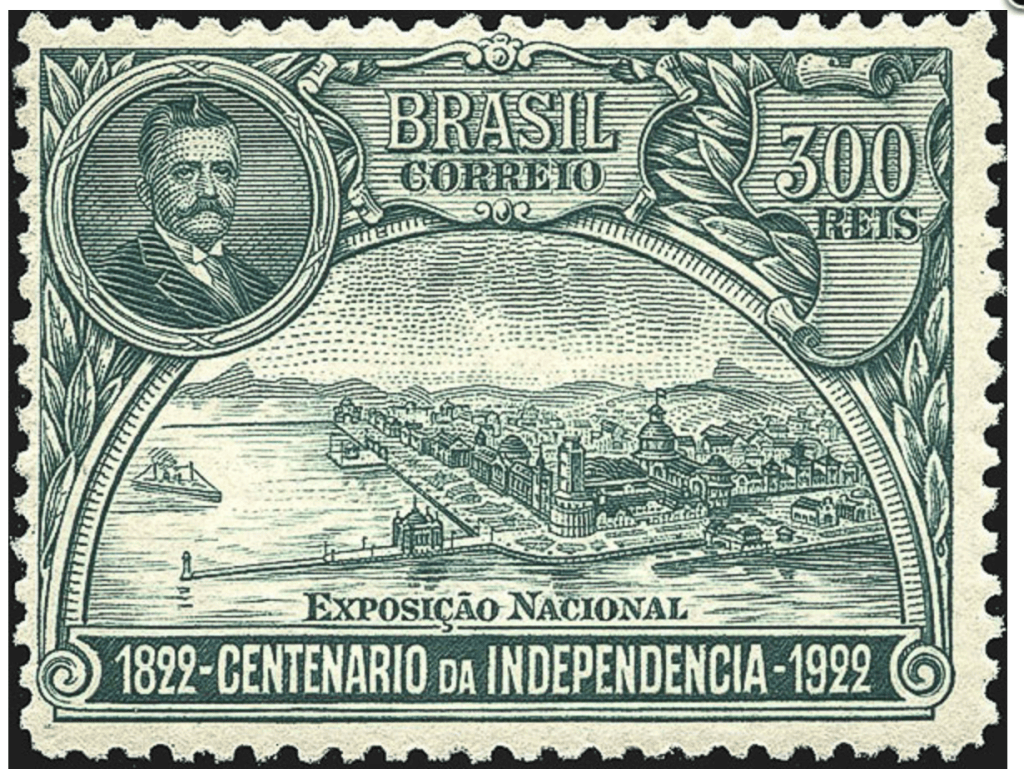
This one arrived in the post, a gift from a friend. Brazil, 1922. Three hundred réis. Slate green, the colour of deep water on an overcast day.
It was made to celebrate a hundred years of Brazilian independence. Rio threw an exhibition for the occasion and built much of it on land that hadn’t existed a few years earlier. They took down a whole hill, the Morro do Castelo, and pushed it into the bay. Then they put up pavilions on top.
That is what the engraver was asked to show. The president in his medallion, top left, moustache and all. The grand new buildings across the water. A dome, a tower, a steamship coming in. Exposição Nacional. A country pleased with itself, and fair enough.
I looked at it for a good while before I saw the lighthouse.
Bottom left. A long breakwater running out into the bay, and at the very end of it, a light. It’s barely a few millimetres tall. A thin vertical mark that could be a flaw in the printing if you weren’t looking for it.
I am always looking for it.
That’s the strange gift of collecting something this narrow. Most people who own this stamp file it under Brazil, or commemoratives, or the 1920s. Nobody files it under lighthouses. The lighthouse isn’t the point of the stamp. It isn’t really the point of anything. It’s there because the engraver was drawing a harbour, and harbours have lights.
But someone had to cut it. Somebody sat with a burin and a magnifying glass in 1922 and carved that tiny tower into a steel plate, knowing nobody would ever notice it. They did it properly anyway.
I like that more than I can sensibly explain.
My friend didn’t have to send it. A stamp in an envelope, no occasion required. That’s a small light at the end of a breakwater too.
There’s a version of a good life that looks like the centre of this stamp. Big buildings, a portrait in a frame, your name in capital letters along the bottom. And there’s another version that looks like the corner. Doing the small, necessary thing at the end of the breakwater, in good weather and bad, whether anyone is watching or not.
A hundred years on, the pavilions are mostly gone. The president is a name in a history book.
The light is still there. On the stamp, at least. Still doing its job.


Leave a Reply