This one I bought. An online auction, a few clicks, a little nervousness at the end. It has been on my list for years.
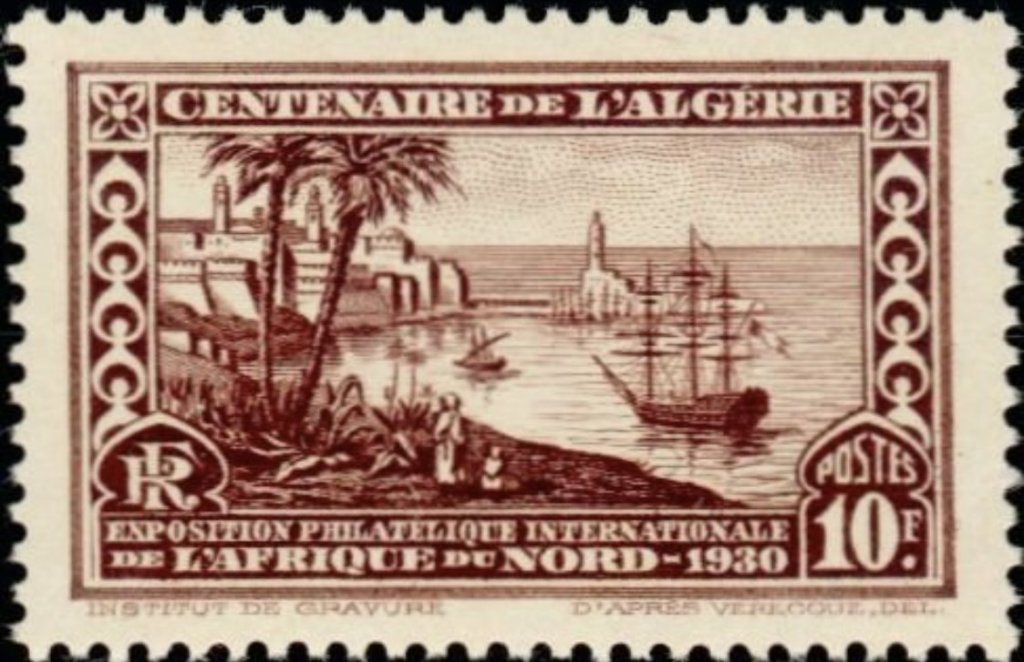
Algeria, 1930. Ten francs. A deep brown-red, the colour of old brick in late sun.
It was issued in May 1930 for the International Philatelic Exhibition of North Africa, held in Algiers. Across the top it says Centenaire de l’Algérie. That’s the centenary of 1830, the year French troops landed and took the city. So it’s a stamp made by one side of a story, to mark a hundred years of its own version.
The engraver gives you the harbour. Palms in the foreground. White walls and minarets climbing the hill on the left. A tall ship at anchor. A small boat under sail, heading somewhere.
And in the middle of it all, a lighthouse.
This time I didn’t have to hunt for it. It stands right at the centre of the picture, pale against the sea.
As far as I can tell, it’s the old light on the Peñón, the rocky islet that sheltered the harbour. Spain fortified it in 1510. Barbarossa took it in 1529, pulled down the fort and joined the rock to the shore. There was a light there before 1700. The tower itself, twelve-sided and white, dates from 1834. It went dark sometime in the 1920s or 30s, around the time this stamp was printed.
Those islets gave the city its name. Al-Jazā’ir. The islands. Alger. Algeria. A whole country named after the rocks the lighthouse stands on.
But that isn’t the detail I keep coming back to.
At the bottom, on the shore under the palms, there are two figures. One standing, one sitting. Both looking out at the ship.
Everything else in the scene is busy. The ship is arriving. The city is being a city. These two are just watching.
I don’t know who the artist meant them to be. I do know what 1830 meant for the people who stood on that shore and watched ships come in. It’s hard to look at them now without wondering what they were thinking.
Then there’s the small print. Under the frame, so faint you need a lens. Institut de Gravure on the left. D’après Verecque, del. on the right. After Verecque, who drew it.
Two lines nobody reads, crediting the people who made the thing.
So that’s three quiet things on one stamp. A light that was about to go out. Two people watching from the edge. A name in the margin.
I waited a long time for this one. Maybe that’s why I looked at it so slowly.
The last stamp was a lighthouse nobody was looking at. In this one, somebody is.


Leave a Reply